


It's one of the questions we hear most often: Can you get sick from drinking a wine that is 30, 40 or 50 years old? The short answer is no. An old wine doesn't turn poisonous. It can become tired, flat or unpleasant to drink – but it won't make you sick.
In this guide we explain why, and we show you what to look out for when you open an old bottle. That way you'll know exactly what is normal, and what is a sign that the wine has gone too far.
Can you get sick from old wine?
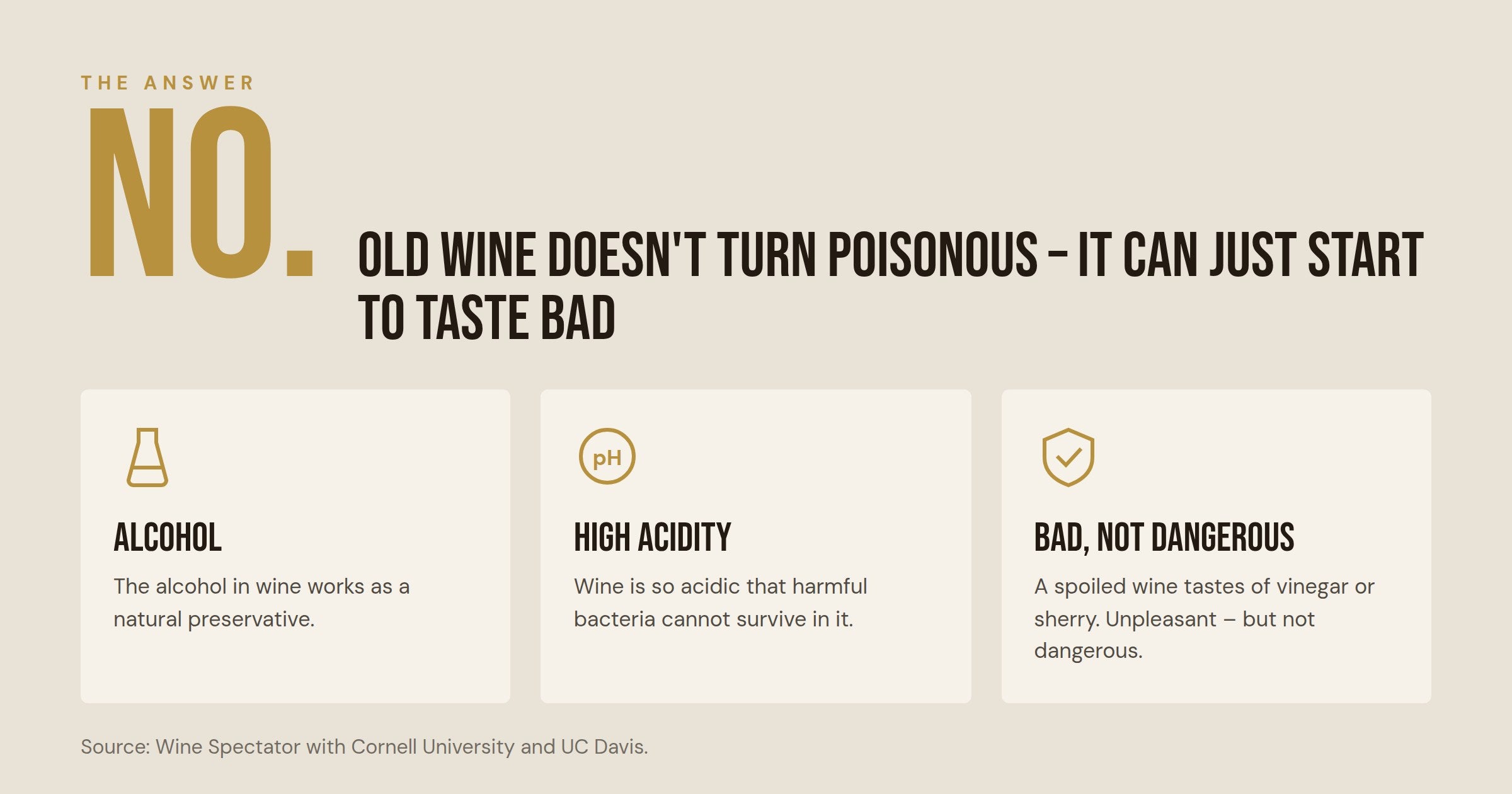
No. Chris Gerling of Cornell University explains to Wine Spectator that no harmful bacteria can survive in wine because of the alcohol and the low pH. Wine is simply too acidic and too alcoholic for the bacteria that cause food poisoning.
The same goes for wine that has spoiled. Professor Linda Bisson of UC Davis says that a spoiled wine "would not be medically or physically harmful, but unpleasant – like drinking vinegar". And Wine Spectator's wine expert Dr. Vinny writes that old wine "won't make you sick if you taste it".
There is one caveat, and it's the obvious one: what can make you ill is drinking too much. That applies to all wine, old and young.
What about a lead capsule?
Older bottles may have a lead capsule over the cork. Lead was originally used to protect the cork from pests. In the US, lead capsules were banned in 1996, and according to Wine Spectator they were phased out in the 1980s.
Wine Spectator writes that there is no direct evidence that the lead capsules were dangerous. Still, the advice is simple: remove the capsule completely, and wipe the rim of the bottle with a damp cloth before you pour.
Before you open: check the bottle
You can read much of the story on the bottle before the cork is even out.
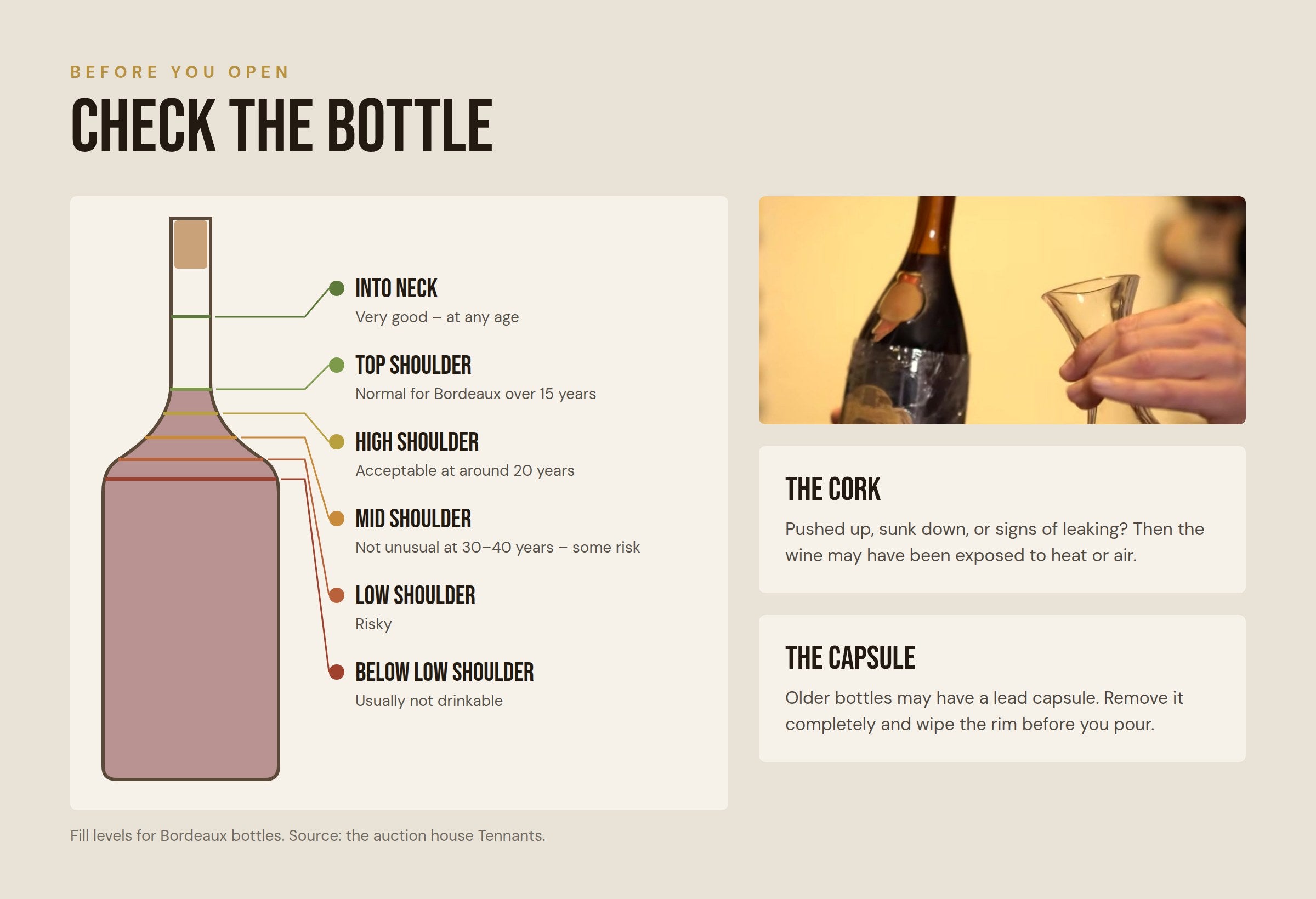
The fill level tells you how much wine has evaporated through the cork over the years. A little is completely normal. The auction house Tennants describes it like this for Bordeaux bottles:
| Fill level | What it means |
|---|---|
| Into neck | Very good – at any age |
| Top shoulder | Normal for Bordeaux over 15 years |
| High shoulder | Acceptable at around 20 years |
| Mid shoulder | Not unusual at 30–40 years, but some risk |
| Low shoulder | Risky |
| Below low shoulder | Usually not drinkable |
Burgundy bottles have a different shape, and here the fill level matters less. Tennants writes that 5–7 cm of air in a 50-year-old Burgundy is normal.
The cork is the next thing to look at. According to Wine Spectator, a leaking cork is the most worrying sign, because air or heat has got in. A cork that has been pushed up can mean the bottle has been stored too warm. A cork that has sunk down can mean temperature swings or a dried-out cork.
Remember that fill level and cork are only clues. The only way to know is to open the bottle and taste.
Look at the color
The color changes as the wine ages – and that is completely normal. Red wine loses color and turns brick red with an orange rim. White wine goes the other way and turns golden, then later amber.
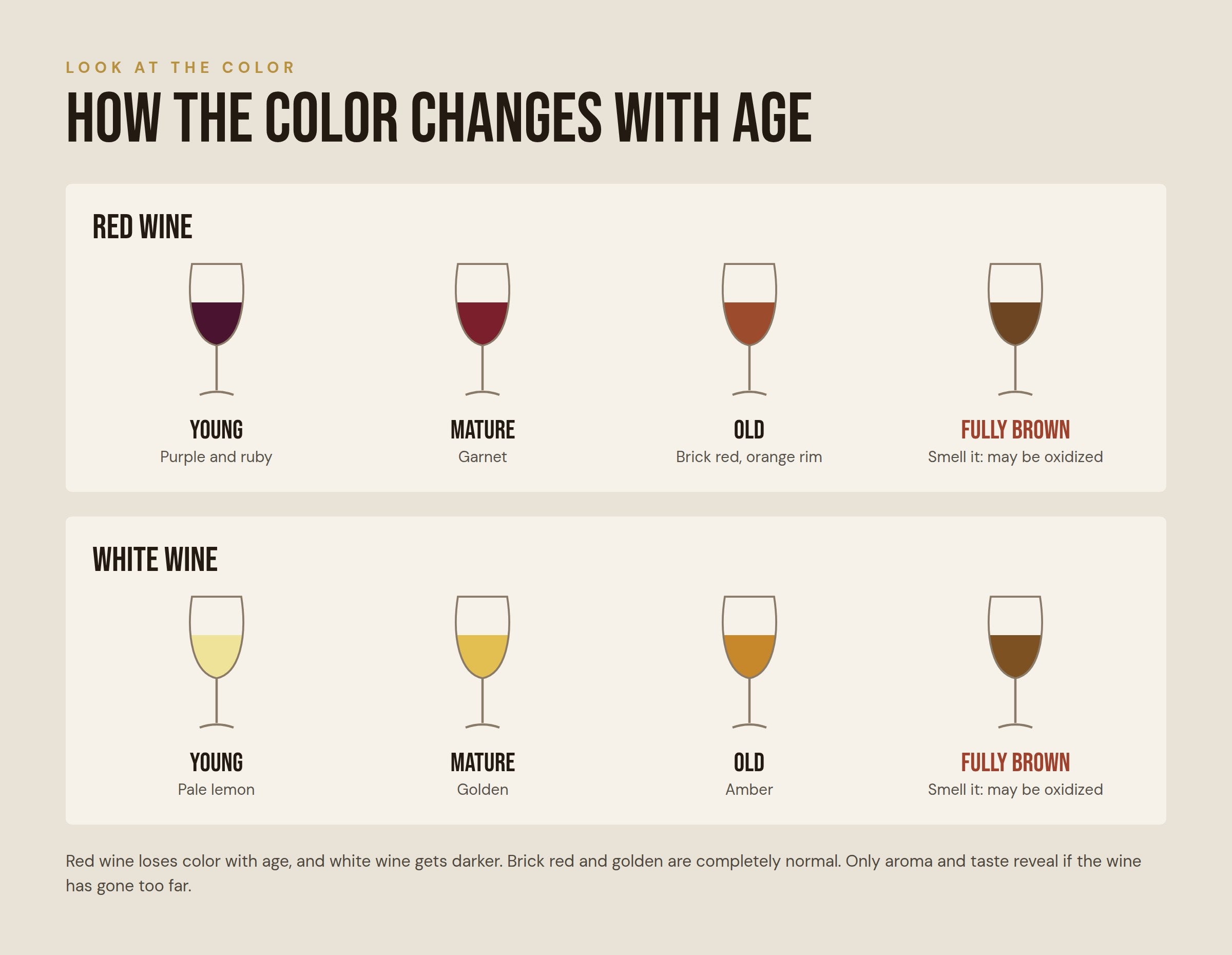
A fully brown color can be a sign of oxidation, meaning the wine has had too much oxygen. But color alone doesn't settle it. Use your nose.
Use your nose: six faults you can smell
Once the wine is in the glass, the aroma reveals most things. Here are the most common faults and how to recognize them. According to Wine Folly, most wine faults are not harmful – they just make the wine less good.
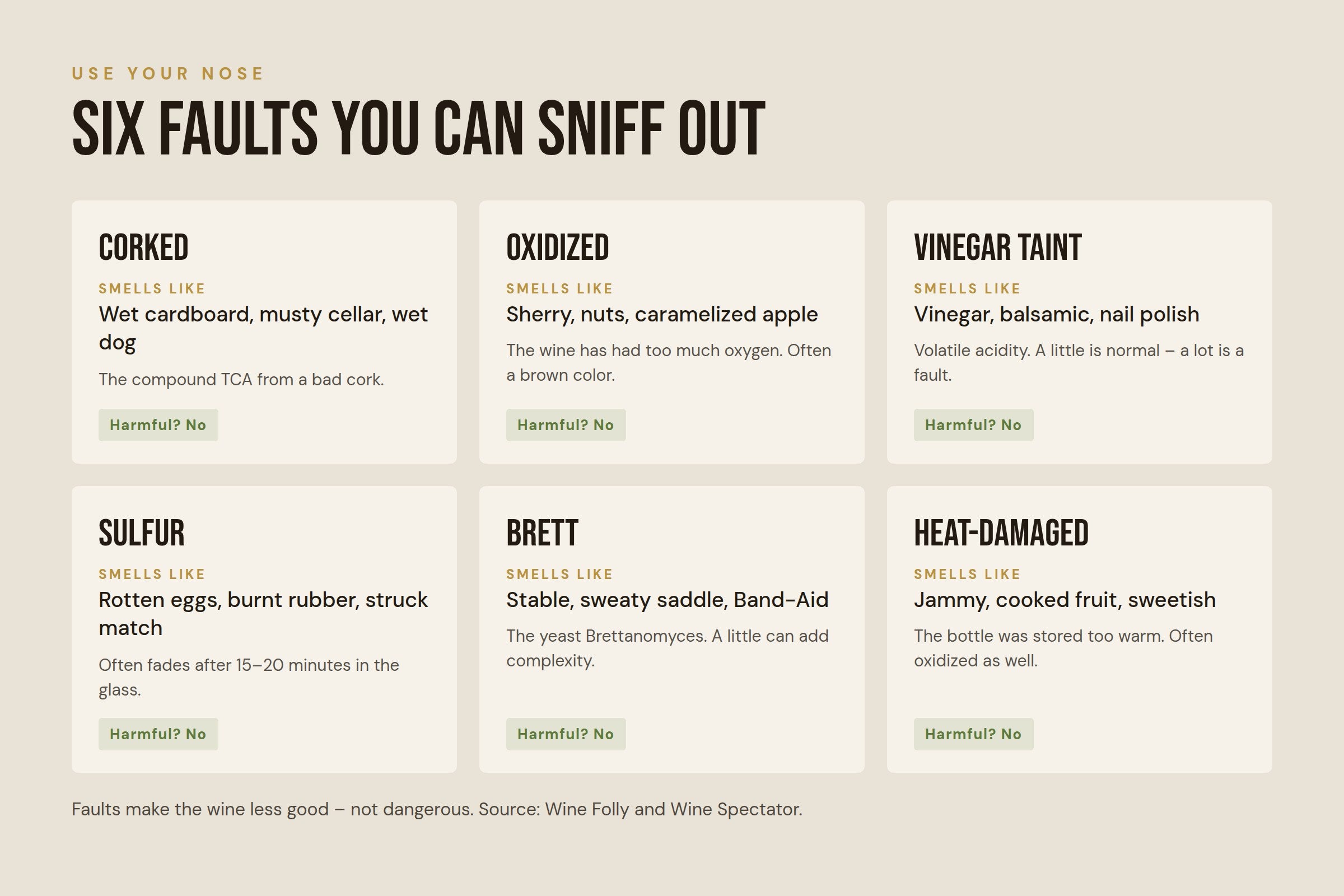
| Fault | Smells like | Good to know |
|---|---|---|
| Corked | Wet cardboard, musty cellar, wet dog | Caused by the compound TCA from the cork |
| Oxidized | Sherry, nuts, caramelized apple | Often with a brownish color |
| Vinegar taint | Vinegar, balsamic, nail polish | Volatile acidity – a little is normal |
| Sulfur | Rotten eggs, burnt rubber, struck match | Often fades after 15–20 minutes |
| Brett | Stable, sweaty saddle, Band-Aid | In small amounts it can add complexity |
| Heat-damaged | Jammy, cooked fruit, sweetish | Often together with oxidation |
The smell of sulfur is the only one that often disappears on its own. So give the wine a quarter of an hour before you write it off.
Looks dangerous – but is harmless
Many people get nervous when they see sediment or mold on an old bottle. There is usually no reason to.
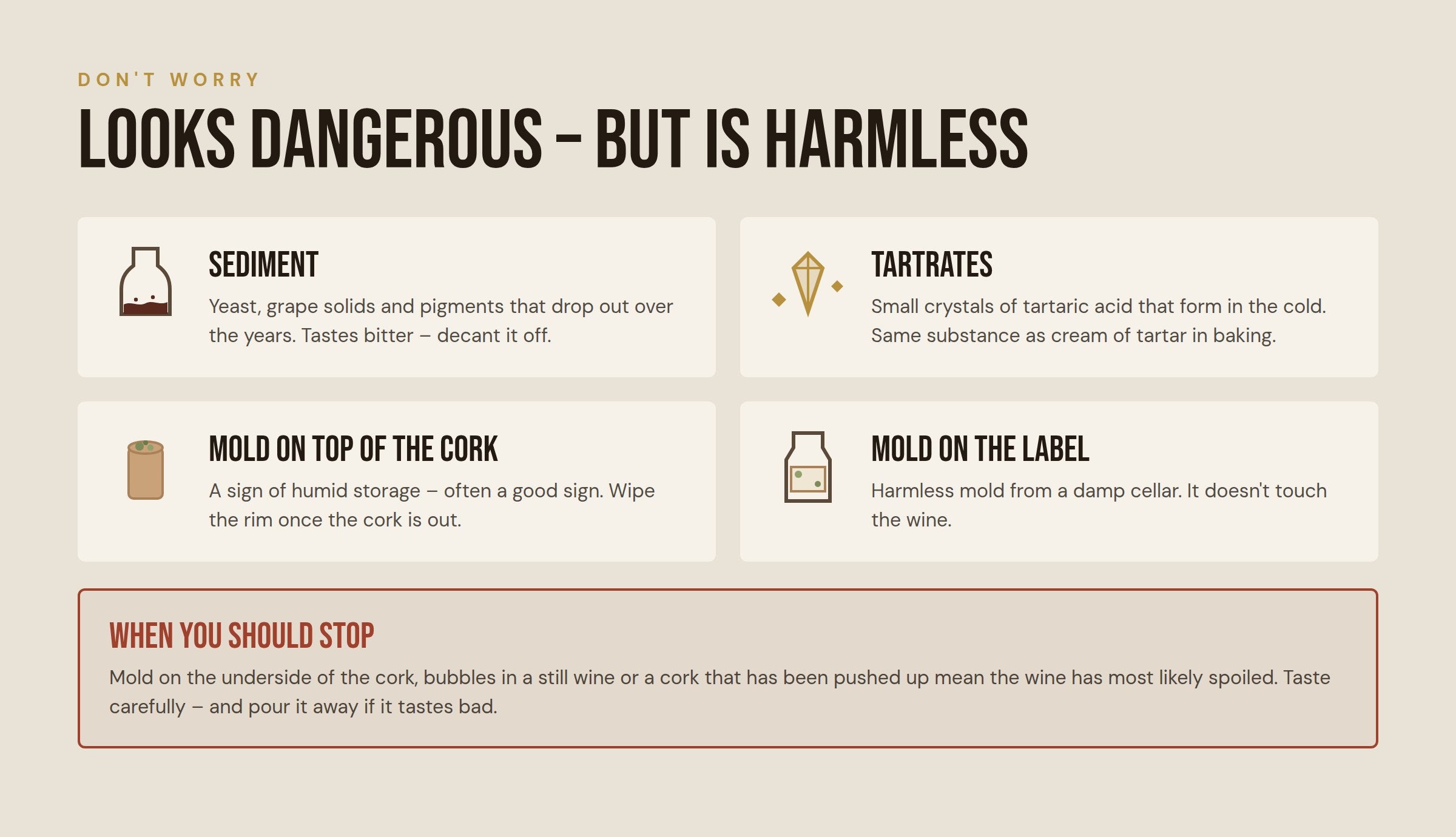
- Sediment, according to Wine Spectator, consists of yeast remnants, grape solids and pigments that drop out as the wine ages. It's harmless, but it tastes bitter and gritty, so decant the wine off it.
- Tartrates are small crystals of tartaric acid that form when the wine gets cold. It's the same substance as cream of tartar in baking, and it's completely harmless.
- Mold on top of the cork is not a warning sign, according to sommelier Calvin Barnett at VinePair. It usually just means the bottle has been kept somewhere humid – and that is good for the cork.
- Mold on the label and capsule is harmless mold from a damp cellar.
When you should stop
Mold on the underside of the cork is a warning sign. So are bubbles in a wine that shouldn't be sparkling, and a cork that has been pushed up or is leaking. Medical News Today names exactly these as signs that the wine may have spoiled. Taste carefully, and pour the wine away if it tastes bad.
Once the bottle is open
An old wine is fragile. Dr. Vinny of Wine Spectator has seen the fine nuances of an old wine vanish within minutes. That's why the advice is to open or decant it just before serving – not several hours ahead.
Want to know how to get the old cork out in one piece? Read our guide on how to open vintage wine. And if you're new to older wines, our guide to vintage wine gives you a good overview.
Stored well, a wine can be superb after many decades. Find your next bottle in our selection of old and vintage wine.
Sources
- Wine Spectator: Jennifer Fiedler, "Health Q & A: What is the Safest Way to Bottle Wine?" (with Chris Gerling, Cornell University).
- Wine Spectator: Dr. Vinny, "Can drinking an old wine make you sick?", March 2014.
- Wine Spectator: Dr. Vinny, "I found some very old wines that weren't stored properly. Are they safe to taste?", March 2019.
- Wine Spectator: Dr. Vinny, "Can an inexpensive wine ever spoil to the point that it could be harmful to drink?", July 2005 (with Linda Bisson, UC Davis).
- Wine Spectator: Dr. Vinny, "Why was lead originally used in wine capsules?", June 2014.
- Wine Spectator: Dr. Vinny, "Which is worse for a wine: leaky, protruding or sunken cork?", November 2018.
- Wine Spectator: Kenny Martin, "What is wine sediment made of, and is it safe to consume?", July 2023.
- US Food and Drug Administration: ban on lead capsules on wine bottles, Federal Register, February 1996.
- VinePair: Olivia White, "Ask a Wine Pro: Is it Safe to Consume Wine With Mold on the Top of the Cork?", July 2025.
- Wine Folly: Madeline Puckette, "7 Wine Faults and How to Sniff Them Out".
- Beverage Information Group: Marnie Old, "Why Are There Crystals in My Wine?", June 2023.
- SAQ: "Shades of white", October 2020.
- Tennants: "Condition and Ullage".
- Medical News Today: Adam Rowden, "How long does it take for wine to spoil?", September 2023.


