


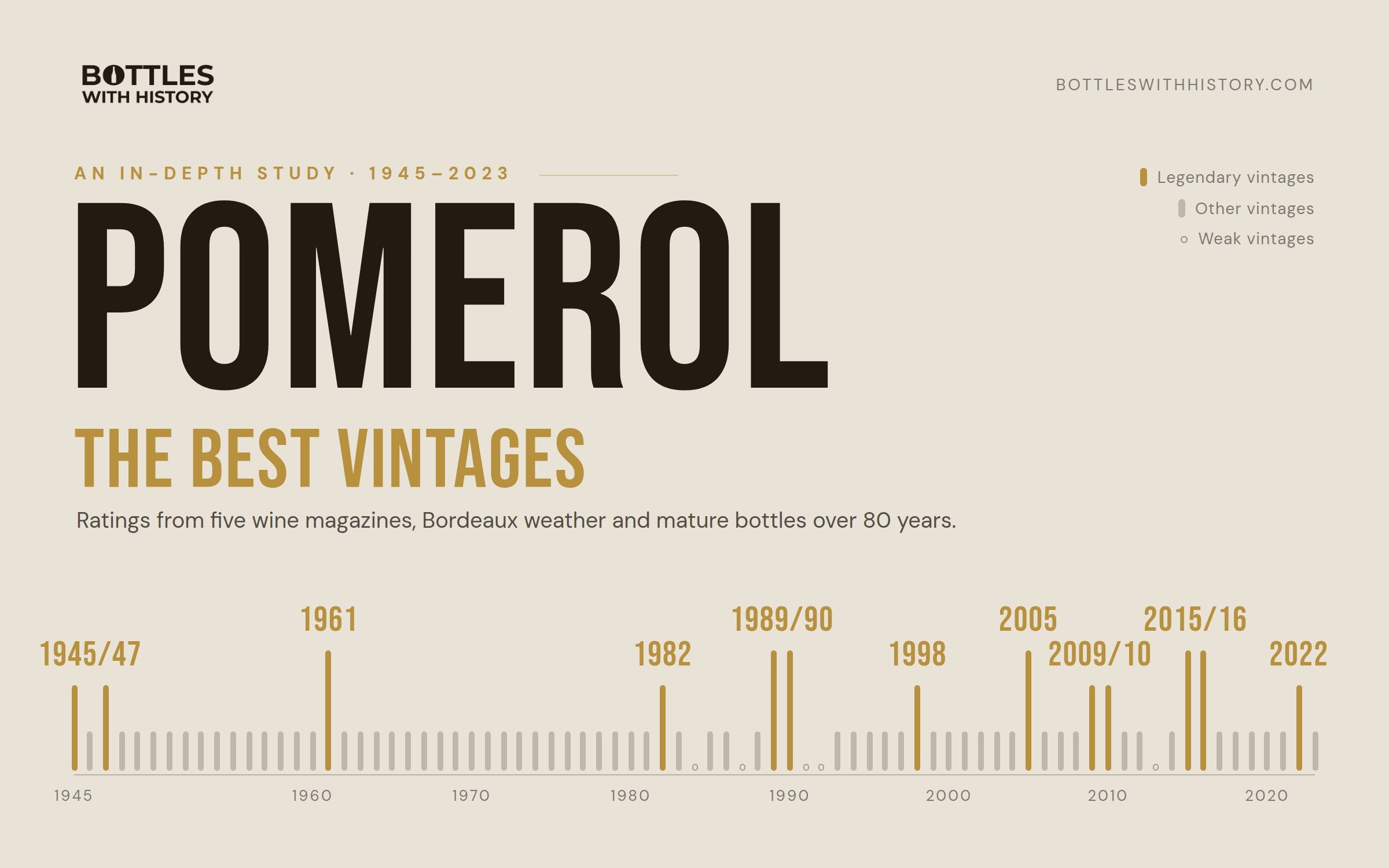
Pomerol is one of Bordeaux' smallest wine regions, yet it makes some of the most sought-after wines in the world. Because almost everything here is Merlot, Pomerol is also very sensitive to the weather. That makes the gap between vintages wider than in many other parts of Bordeaux.
In this article we have gathered what the leading wine critics have written about Pomerol's vintages over the decades. We have compared their ratings with the weather in each year and with how the wines drink today. The aim is to give you an honest answer to which vintages are the best, and when to open them.
Pomerol in brief
Pomerol lies on Bordeaux' Right Bank, just north of Saint-Émilion. It covers only 0.7 % of Bordeaux' vineyards. That is smaller than Saint-Julien, writes wine journalist Colin Hay in Decanter.
Even so, some of the world's most expensive wines come from here. Pétrus, Le Pin and Lafleur are made in very small amounts. According to Decanter's Jane Anson, Le Pin rarely makes more than 500 cases a year. Colin Hay says Pomerol's reputation was only truly secured when Robert Parker praised the 1982 wines.
| Facts | Pomerol |
|---|---|
| Area | Approx. 790–815 ha (sources vary) |
| Producers | Approx. 140 |
| Average vineyard | Approx. 5.6 ha |
| Grapes | Approx. 80 % Merlot, 15 % Cabernet Franc, the rest Cabernet Sauvignon and others |
| Soil | Gravel, clay and sand over an iron-rich subsoil (“crasse de fer”) |
| Appellation | AOC since 1936, red wine only |
| Classification | None – Pomerol has always refused to create one |
| Famous châteaux | Pétrus, Le Pin, Lafleur, Vieux Château Certan, La Conseillante, L'Église-Clinet, Trotanoy, La Fleur-Pétrus, L'Évangile, Gazin, Clinet |
The most famous patch of ground is the blue clay under Pétrus. According to Pétrus' own technical data, the clay is at least 40 million years old, while the gravel on the surrounding plateau is only one million years old. The clay holds on to water in dry years. That is one reason Pomerol often does well in hot vintages.
Sources: Syndicat Viticole de Pomerol; Colin Hay, “Understanding Pomerol at three price points”, Decanter, June 2022; Pétrus' technical data sheets via the importer Dreyfus Ashby.
How we researched the vintages
Pomerol is made up of about 140 different producers. So here we look at the vintages for the whole appellation, not at one single wine.
- Vintage ratings. We have gathered the vintage charts of the major wine magazines: Wine Spectator, Robert Parker Wine Advocate, Decanter, Wine Enthusiast and Berry Bros & Rudd. They rate the whole region for each vintage.
- The growing season. The weather explains most of it. Merlot ripens early and is sensitive to frost, rain and rot, so weak years hit Pomerol harder than the Médoc.
- Tastings of finished wines. We have used articles where the critics tasted the wines from bottle, including many years later.
Two caveats matter. The charts do not all cover the same area: Wine Spectator groups Pomerol and Saint-Émilion together, while Wine Advocate has a separate Pomerol row. And before 1995, Wine Spectator's chart covers all of Bordeaux. So we rely most on vintages where several sources point the same way.
Every vintage and its ratings
The table shows how the major wine magazines rate each vintage in Pomerol. These are ratings for the whole region, not for individual wines. A blank field means the source has not rated that vintage.
| Vintage | Wine Spectator (100) | Wine Advocate (100) | Decanter (5 stars) | Wine Enthusiast (100) | Berry Bros & Rudd (10) | Our rating |
|---|---|---|---|---|---|---|
| 2023 | 90 | 94 | – | – | 8 | Very good |
| 2022 | 97 | 96 | – | – | 9 | Legendary |
| 2021 | 84 | 87 | – | – | 7 | Uneven |
| 2020 | 92 | 95 | – | – | 9 | Outstanding |
| 2019 | 92 | 96 | – | – | 8 | Outstanding |
| 2018 | 94 | 93 | – | – | 9 | Outstanding |
| 2017 | 93 | 91 | – | – | 7 | Good |
| 2016 | 94 | 97 | – | 97 | 10 | Legendary |
| 2015 | 97 | 94 | – | 96 | 9 | Legendary |
| 2014 | 91 | 94 | – | 95 | 8 | Very good |
| 2013 | 86 | 84 | – | 87 | 5 | Weak |
| 2012 | 90 | 94 | – | 90 | 8 | Very good |
| 2011 | 91 | 88 | – | 90 | 5 | Good |
| 2010 | 98 | 95 | – | 97 | 10 | Legendary |
| 2009 | 96 | 98 | – | 96 | 10 | Legendary |
| 2008 | 88 | 96 | 4 | 92 | 7 | Very good |
| 2007 | 86 | 86 | 3 | 88 | 6 | Good |
| 2006 | 89 | 90 | 3 | 89 | 7 | Good |
| 2005 | 97 | 95 | 4 | 98 | 10 | Legendary |
| 2004 | 88 | 88 | 4 | 91 | 7 | Good |
| 2003 | 88 | 84 | 4 | 88 | 8 | Uneven |
| 2002 | 87 | 85 | 4 | 87 | 6 | Good |
| 2001 | 91 | 90 | 4 | 95 | 8 | Very good |
| 2000 | 93 | 95 | 5 | 97 | 10 | Outstanding |
| 1999 | 85 | 88 | 4 | 88 | 7 | Good |
| 1998 | 95 | 96 | 5 | 92 | 8 | Legendary |
| 1997 | 86 | 87 | 3 | 85 | 5 | Good |
| 1996 | 87 | 85 | 4 | 86 | 9 | Good |
| 1995 | 95 | 92 | 5 | 91 | 8 | Outstanding |
| 1994 | 85* | 89 | 3 | 86 | 5 | Good |
| 1993 | 82* | 87 | 3 | 86 | 5 | Uneven |
| 1992 | 72* | 82 | 2 | 80 | 3 | Weak |
| 1991 | 72* | 58 | 1 | – | 5 | Weak |
| 1990 | 97* | 96 | 5 | – | 10 | Legendary |
| 1989 | 98* | 96 | 5 | – | 9 | Legendary |
| 1988 | 93* | 89 | 4 | – | 8 | Very good |
| 1987 | 76* | 85 | 1 | – | 5 | Weak |
| 1986 | 95* | 87 | 3 | – | 8 | Good |
| 1985 | 93* | 88 | 5 | – | 8 | Very good |
| 1984 | 70* | 65 | 2 | – | 5 | Weak |
| 1983 | 86* | 90 | 3 | – | 7 | Good |
| 1982 | 95* | 96 | 5 | – | 10 | Legendary |
| 1976 | 80* | 82 | 4 | – | – | Good |
| 1975 | 85* | 94 | 3 | – | – | Uneven |
| 1970 | – | 90 | 5 | – | – | Outstanding |
| 1961 | – | – | 5 | – | – | Legendary |
* Wine Spectator's ratings before 1995 apply to all of Bordeaux, not just the Right Bank. From 1995, Wine Spectator groups Pomerol and Saint-Émilion together. Decanter's chart also groups Pomerol and Saint-Émilion, and it ends with 2008. Berry Bros & Rudd rates all of Bordeaux as one.
How to read the table: Ten vintages get a top rating from at least two sources: 1982, 1989, 1990, 1998, 2005, 2009, 2010, 2015, 2016 and 2022. These are the ones we call legendary. Also note where the sources disagree. 2008 gets 96 from Wine Advocate, but only 88 from Wine Spectator. And 1975 gets 94 from Wine Advocate, while Decanter writes that some Pomerol wines have dried out.
Sources for the table: Wine Spectator, “Vintage Charts: Bordeaux/Right Bank Reds (Pomerol, St.-Emilion)” and “Bordeaux: Vintage Reds Pre-1995”; Robert Parker Wine Advocate, “The Wine Advocate Vintage Guide”, Bordeaux: Pomerol (read October 2026); Decanter, “Saint-Emilion and Pomerol Vintage Guide”, Georgie Hindle, updated September 2019; Wine Enthusiast, “2018 Vintage Chart”; Berry Bros & Rudd, “Vintage chart”.
The best vintages in detail
Here is the story behind the vintages that made Pomerol famous – from the legendary post-war years to the latest top scorers.
1945, 1947 and 1961 – the legends
Both Wine Spectator and Wine Enthusiast list 1945 and 1947 among Bordeaux' great older vintages. In 2013, Neal Martin of Wine Advocate wrote that the fame of 1947 “rests more on the Right Bank”, with legendary Pomerols such as Pétrus, Lafleur and Vieux Château Certan. Of Vieux Château Certan 1947 he wrote that it feels “as fresh and vibrant as the day it was born”.
1961 gets five stars from Decanter. Cold, rain and drought cut the crop before a sunny September saved it. Decanter names Pétrus, Trotanoy, La Fleur-Pétrus and Beauregard as the best Pomerols of the year.
1982 – the vintage that made Pomerol world-famous
1982 gets 96 points from Wine Advocate and five stars from Decanter. Early September was unusually hot and dry, and the harvest came early. Decanter calls it “a great year for Pomerol” and singles out Certan de May, La Conseillante, L'Évangile, Pétrus and Trotanoy, among others.
1989 and 1990 – the twins
Two hot years in a row, both rated 96 points by Wine Advocate and five stars by Decanter. In 1989 the summer was the hottest since the 1940s, and the harvest the earliest in almost a hundred years. For 1990, Decanter writes that the Merlot was “of exceptional quality, with very high sugar levels and plenty of tannin”.
1998 – the Right Bank's year
In 1998 Pomerol did far better than the Médoc. August was hot and dry, and the Merlot was picked on 21–25 September in ideal conditions. Wine Spectator calls the vintage “much better than the Left Bank”, and Decanter compares the Pomerols with 1982 and 1990. In 2020, Jane Anson called it “a truly legendary year on the Right Bank”.
2005 – the vintage to remember
Wine Enthusiast gave 98 and Wine Spectator 97, noting “fantastic Pomerols”. At Pétrus and Trotanoy the harvest began about two weeks early. Christian Moueix, of the family behind Pétrus and Trotanoy, said he had not seen anything like it in many years. Pomerol's own wine association calls 2005 an “exceptional vintage that will remain legendary”.
2009 and 2010 – the modern pair
2009 gets 98 from Wine Advocate, and Wine Spectator writes that “Pomerol shone”. 2010 gets 98 from Wine Spectator and 97 from Wine Enthusiast. 2009 is the more generous and approachable of the two, while 2010 has more acidity and structure. Pomerol's wine association itself points to the likeness between the trio 1988, 1989 and 1990 and the trio 2008, 2009 and 2010.
2015 and 2016 – two great years in a row
Here the critics disagree on the order. Wine Spectator rates 2015 higher (97 against 94), while Wine Advocate and Wine Enthusiast prefer 2016 (97 points). 2015 was very hot and dry, and the wines are rich and layered. In 2016 the vineyards on clay came through the drought best. Pétrus 2016 got 100 points from James Suckling and 98 from Decanter and Wine Enthusiast.
2019 and 2022 – the new top scorers
Jane Anson called 2019 “a clear contender for appellation of the vintage”. In July the temperature reached 41 °C, and Christian Moueix was about to apply for permission to irrigate when 43 mm of rain fell on 27 July. She saw three wines with 100-point potential and named L'Église-Clinet wine of the vintage.
2022 gets 97 from Wine Spectator, which calls the wines “hedonistic”. The year was so dry that Pomerol's growers were allowed to irrigate for the first time. The harvest was the earliest ever, writes Georgie Hindle in Decanter. Her favourite was La Conseillante, closely followed by Lafleur, Pétrus, Vieux Château Certan and L'Église-Clinet.
When to drink the vintages
Pomerol's own wine association writes that most Pomerols are at their best between 5 and 15 years old. The greatest wines from the strongest vintages can last far longer. The table shows where the critics place the key vintages today.
| Vintage | Status in 2026 | Basis |
|---|---|---|
| 2022 | Keep | Wine Spectator: “hold”; Wine Advocate: still young and tannic |
| 2020 | Keep | Wine Spectator: “hold”; Wine Advocate: young and tannic |
| 2019 | Drinkable, but best kept | Wine Spectator: “hold”; Berry Bros & Rudd: ready, but youthful |
| 2018 | Keep | Wine Spectator: “hold”; Berry Bros & Rudd: not ready |
| 2017 | Drink now or keep | Wine Spectator: “drink or hold” |
| 2016 | Drinkable, but will develop | Wine Spectator: “drink or hold”; Wine Advocate: young and tannic |
| 2015 | Keep | Wine Spectator: “hold” |
| 2014 | Drink now or keep | Wine Spectator: “drink or hold” |
| 2012 | Drink now | Wine Spectator: “drink”; Wine Advocate: early-drinking |
| 2010 | Keep | Wine Spectator: “hold”; Wine Advocate: young and tannic |
| 2009 | Drink now or keep | Wine Spectator: “drink or hold”; Wine Advocate: early-drinking |
| 2008 | Drink now | Wine Spectator: “drink” |
| 2005 | Drink now or keep | Wine Spectator: “drink or hold” |
| 2001 | Drink now | Wine Spectator: “drink”; Decanter: “drink now” |
| 2000 | Drink now or keep | Wine Spectator: “drink or hold” |
| 1998 | Drink now or keep | Wine Spectator: “drink or hold” |
| 1995 | Drink now or keep | Wine Spectator: “drink or hold” |
| 1990 and 1989 | Drink now | Wine Advocate: ready to drink |
| 1988 and 1985 | Drink now | Wine Advocate: ready to drink |
| 1982 | Drink now | Wine Advocate: ready to drink; Decanter: “drink soon” |
| 2003 and 2013 | Drink up | Wine Spectator: past their peak |
For all older bottles, storage matters more than the vintage. A well-stored bottle from an average year can be better than a poorly stored bottle from a great year. Always check the fill level, cork and label.
Underrated vintages – and the ones to be careful with
The legendary vintages are also the most expensive. The Bordeaux Wine Council (CIVB) itself names six vintages it considers underrated: 2001, 2007, 2008, 2012, 2014 and 2017.
Underrated vintages
| Vintage | Why it is worth looking for | Source |
|---|---|---|
| 2008 | Wine Advocate gives 96 points, and Decanter calls the quality “quite exciting, especially in Pomerol”. Wine Spectator is more reserved with 88. | Wine Advocate; Decanter; Wine Spectator |
| 2012 | 94 points from Wine Advocate, which calls the vintage early-drinking. Drinking well now. | Wine Advocate; CIVB |
| 2014 | 94 from Wine Advocate and 95 from Wine Enthusiast – scores on a par with far more expensive vintages. | Wine Advocate; Wine Enthusiast |
| 2001 | Overshadowed by 2000, but Wine Enthusiast gives 95 points. Ready to drink now. | Wine Enthusiast; Decanter |
| 1988 | The opening of the 1988–1990 trio. Wine Spectator lists Pomerol among the year's best regions. | Wine Spectator; Syndicat Viticole de Pomerol |
| 1985 | Five stars from Decanter and 93 from Wine Spectator, yet rarely mentioned alongside 1982. | Decanter; Wine Spectator |
Vintages to be careful with
Because Pomerol grows almost nothing but Merlot, frost and rain hit hard. These vintages require you to know the producer.
| Vintage | What happened | Source |
|---|---|---|
| 1991 | A severe April frost left only about 20 % of a normal crop. Many leading châteaux did not sell the wine under their own name at all. Wine Advocate gives 58 points. | Decanter; Wine Advocate |
| 1984 | Merlot was hit especially hard, and a hurricane struck on 5 October. Only Pétrus and Trotanoy made wines “of even the slightest interest” in Pomerol, writes Decanter. | Decanter |
| 1987 and 1992 | Rain during the harvest and widespread rot. In 1992, though, Pomerol did better than Saint-Émilion. | Decanter |
| 2003 | Heatwave. Wine Spectator writes that many wines turned jammy and have not aged well. | Wine Spectator |
| 2013 | Called “possibly the most difficult of the last two decades”. Wine Spectator rates the wines as past their peak. | Decanter; Wine Spectator |
| 2021 | Frost and a very wet June. Wine Spectator calls it “the most inconsistent vintage in a generation”, though with Pomerol ahead of Saint-Émilion. | Wine Spectator |
One special case is 1975. Wine Advocate gives 94 points, but Decanter writes that some Pomerol wines have dried out. Here everything depends on the individual bottle.
Pomerol at Bottles With History
At Bottles With History we have mature Pomerols from several of the vintages mentioned in this article. Here is a selection that was in stock when the article was written:
| Vintage | Wine | Why it is interesting |
|---|---|---|
| 1985 | Clos Toulifaut Pomerol 1985 | Five stars from Decanter and one of the underrated vintages |
| 1988 | La Croix du Casse 1988 | The start of the 1988–1990 trio |
| 1990 | Château Rouget 1990 | One of the legendary vintages, ready to drink |
| 2005 | Chevalier Beaurignac Pomerol 2005 | 97–98 points for the vintage from Wine Spectator and Wine Enthusiast |
| 2012 | Château Gazin 2012 | One of Pomerol's well-known châteaux in an underrated vintage |
We also have Pomerol from 1976, 1986, 1993, 1995, 1997 and 2008, among others. See the full range in our Pomerol wine collection, or explore the neighbours in Saint-Émilion and the rest of Bordeaux. New to older wines? Our guide to vintage wine gives you a good overview.
How to choose the right vintage
- To drink now: Choose a mature vintage such as 1985, 1988, 1990 or 2001. Merlot turns soft and spicy with age, with notes of truffle, leather and dried berries.
- For the cellar: Choose 2010, 2015, 2016 or 2022. The critics still advise keeping them.
- As a gift with history: A vintage from the recipient's birth year or an anniversary year. In weak years such as 1984, 1987 and 1991, it is extra important to choose a good producer.
What to check on older bottles
- The fill level. The higher the wine reaches into the neck, the better. A low level can suggest the bottle has been stored too warm.
- The cork. The cork must not be pushed up or show signs of leakage.
- The storage. Always ask where the bottle has been kept. Cool, dark and stable is best.
- Opening. Old bottles are best opened with an Ah-So cork puller, as the cork can be brittle. Decant gently to leave the sediment behind.
Sources
- Wine Spectator: “Vintage Charts: Bordeaux/Right Bank Reds (Pomerol, St.-Emilion)” and “Bordeaux: Vintage Reds Pre-1995”.
- Robert Parker Wine Advocate: “The Wine Advocate Vintage Guide”, Bordeaux: Pomerol (read October 2026), and “Vintage Chart 1970–2023”, October 2024.
- Robert Parker Wine Advocate: Neal Martin, “If You Can't Take The Heat… Bordeaux 1947”, November 2013.
- Decanter: Georgie Hindle, “Saint-Emilion and Pomerol Vintage Guide”, updated September 2019.
- Decanter: Colin Hay, “Understanding Pomerol at three price points”, June 2022.
- Decanter: Gareth Birchley, “The Bordeaux vintage guide to years ending in 4”, July 2024.
- Decanter: Jane Anson, “A 'monumental' tasting of Petrus, Le Pin and Lafleur 1998 and 1999”, September 2020.
- Decanter: Jane Anson, “Best Pomerol 2019 wines tasted en primeur”, June 2020.
- Decanter: Georgie Hindle, “The best Pomerol 2022 in bottle”, March 2025.
- Wine Enthusiast: “2018 Vintage Chart”.
- Berry Bros & Rudd: “Vintage chart”.
- Syndicat Viticole de Pomerol: on the appellation, terroir and vintages.
- Dreyfus Ashby: technical data sheets for Pétrus 2016 and 2017.


