


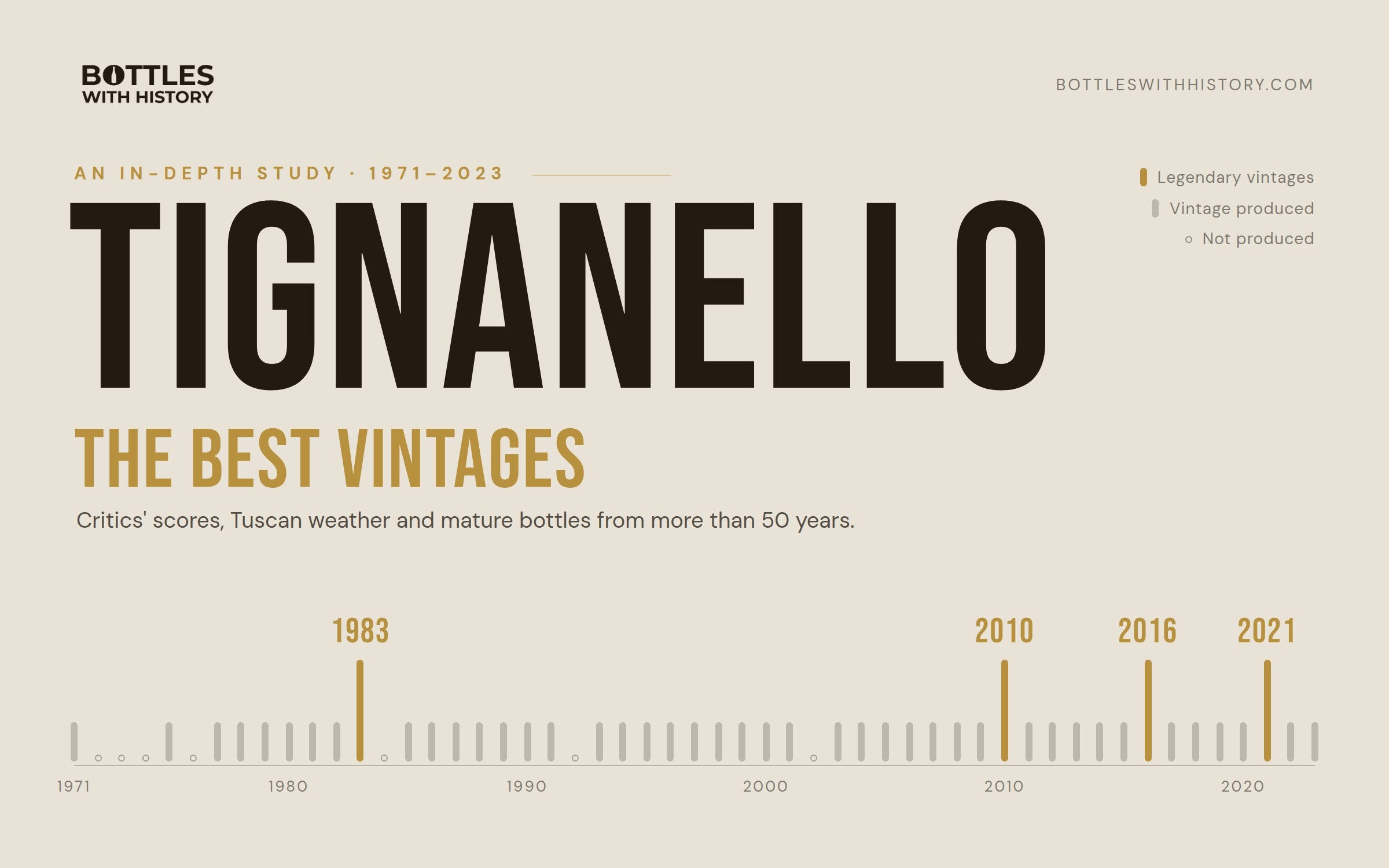
Tignanello is one of the wines that changed Italian wine for good. But the vintages are far from equal. Some years give a wine that is still evolving after 30 years, while others are best drunk young.
In this article we have gathered what the leading wine critics have written about Tignanello over the decades. We have compared their scores with the Tuscan weather and with how the bottles drink today. The goal is simple: to give you an honest answer on which vintages are the best, and when to open them.
Tignanello in brief
Tignanello is a single-vineyard wine from Marchesi Antinori in the heart of Chianti Classico. It was first made in 1970 as a Chianti Classico Riserva from the Tignanello vineyard. From 1971 it left the Chianti rules behind and was sold as a Tuscan table wine under its own name. It was one of the first examples of what we now call a Super Tuscan.
According to Antinori, it was the first Sangiovese to be aged in small French barriques. From 1975 the white grapes were dropped from the blend, and since 1982 the recipe has been around 80–85 % Sangiovese, 10–15 % Cabernet Sauvignon and about 5 % Cabernet Franc. The exact split varies a little from year to year.
| Facts | Tignanello |
|---|---|
| Producer | Marchesi Antinori |
| Vineyard | One single plot of about 77 ha |
| Altitude | 350–400 m above sea level, facing southwest |
| Soil | Stony, lime-rich soil with alberese and marl |
| Grapes | 80–85 % Sangiovese, 10–15 % Cabernet Sauvignon, about 5 % Cabernet Franc |
| First vintage | 1970 (as Chianti Classico Riserva), 1971 as Tignanello |
| Not produced | 1972, 1973, 1974, 1976, 1984, 1992 and 2002 |
The last row is worth noting. Antinori only bottles Tignanello in years it judges good enough. In weak years the grapes go into other wines instead. That alone tells you there is no “bad” Tignanello vintage in the classic sense. The difference lies between good, great and truly exceptional years.
Source: Marchesi Antinori, the producer's own description of Tignanello.
How we assessed the vintages
We judged each vintage on three things: the critics' scores, the weather in the growing season and how the wine has developed in the bottle.
- Critics' scores. We collected scores from Wine Advocate (Robert Parker), Vinous (Antonio Galloni), James Suckling, Wine Spectator, Wine Enthusiast, Falstaff and Gambero Rosso. We only included scores we could find documented.
- The growing season. Antinori describes the weather for each vintage. This explains a lot about why a vintage is powerful, elegant or short-lived.
- Mature bottles. Critics usually score a wine while it is young. So we also looked at vertical tastings, where old and new vintages were tasted side by side many years later.
Two caveats matter. First, Antinori naturally highlights the highest scores on its own website. Second, scores for the oldest vintages are scattered and were given at different times. So we lean most on vintages where several independent sources point the same way.
All vintages and their scores
The table brings together the scores we found documented for each vintage. An empty cell means we could not find a documented score from that critic. It does not mean the wine is poor.
| Vintage | Wine Advocate | Vinous | James Suckling | Wine Spectator | Other sources | Our rating |
|---|---|---|---|---|---|---|
| 2022 | 97 | – | 96 | – | – | Outstanding |
| 2021 | 98 | 98 | – | 97 | Falstaff 97, Gambero Rosso 96 | Legendary |
| 2020 | – | 96 | 97 | – | Gambero Rosso 93 | Very good |
| 2019 | 96 | 95 | 95 | 96 | – | Outstanding |
| 2018 | 98 | 97 | 96 | – | Wine Enthusiast 97 | Outstanding |
| 2017 | 96 | 95 | 96 | – | Wine Enthusiast 97 | Very good |
| 2016 | 97 | 98 | 97 | 97 | Wine Enthusiast 99 | Legendary |
| 2015 | 96 | 98 | 98 | 97 | – | Outstanding |
| 2014 | – | 96 | – | – | – | Good |
| 2013 | 96 | – | 97 | – | Gambero Rosso 91 | Very good |
| 2012 | – | – | 96 | – | – | Very good |
| 2010 | 94 | 96 | 96 | – | – | Legendary |
| 2006 | 92 | – | – | 93 | Wine Enthusiast 94, Decanter 96 (tasted 2018) | Outstanding |
| 2005 | – | 95 | – | – | – | Very good |
| 2004 | – | 94 | – | – | Gambero Rosso 95 (tasted 2024) | Outstanding |
| 2001 | – | 92 | – | – | Australian Wine and Drinks Review 96 (tasted 2016) | Outstanding |
| 1999 | – | 94 | – | – | World of Fine Wine 92 | Outstanding |
| 1997 | 93 | 91 | – | 95 | World of Fine Wine 98, Gambero Rosso 91 | Very good |
| 1985 | – | – | – | – | Decanter World Wine Awards 94 | Outstanding |
| 1983 | – | – | – | – | Gambero Rosso 96 (tasted 2024) | Legendary |
| 1978 | – | – | – | – | Gambero Rosso 90 (tasted 2024) | Good |
How to read the table: Most modern vintages score between 94 and 98 points. So the gap between a good and a legendary vintage is often just 1–3 points. This is where agreement between the critics matters most. For 2016, all five critics give 97 points or more, and for 2021, Wine Advocate, Vinous and Wine Spectator give 97–98 points.
Sources for the table: Marchesi Antinori (published scores by vintage), Wine Spectator Top 100 (2022 and 2024), Vinous (Antonio Galloni, “Antinori: Tignanello and Solaia Revisited”, November 2008), Gambero Rosso (Lorenzo Ruggeri, vertical tasting, November 2024), Rare Wine Invest (score overview 2015–2019, 2022), Australian Wine and Drinks Review (Andrew Graham, vertical 1997–2013, July 2016) and scores quoted by the merchants Bordeaux Index and World of Fine Wine. Wine Advocate and Wine Spectator scores for 2006 and 2010 are quoted from merchants and not confirmed directly with the critics.
The best vintages up close
Five vintages stand out when you combine scores, weather and maturity: 2021, 2016, 2010, 2015 and 1983. Here is what makes each of them special.
2021 – the modern top scorer
2021 is the highest-rated Tignanello in recent times, with 98 points from both Wine Advocate and Vinous. Wine Spectator gave it 97 points and named it No. 3 on its Top 100 list in 2024. Critic Bruce Sanderson describes “pure cherry, strawberry, graphite and tobacco” and “sleek, refined tannins”.
The growing season was long and slow. A cool April delayed growth, the summer was hot and dry, and late rain showers in August helped the grapes along. Antinori itself calls it “one of the best vintages ever”. Writing in 2024, Gambero Rosso's Lorenzo Ruggeri said it is hard to say whether this is the best Tignanello ever. But he expects it to be debated for decades.
2016 – the one everyone agrees on
No vintage has such broad agreement behind it as 2016. Wine Enthusiast gave it 99 points, Vinous 98, and both Wine Advocate and Wine Spectator gave 97. The summer was hot and dry without severe heatwaves, and the harvest went normally.
The Dutch merchant Fine Wine Library calls 2016 “one of the two or three greatest” Tignanello vintages and writes: “If you can still find it, buy it.” At an American vertical tasting in 2024 of the 1990–2020 vintages, 2016 was among the top three favourites, with sweet red fruit and an acidity that can carry the wine for many years.
2010 – the classic that is still waiting
2010 was an almost perfect growing season in Tuscany. James Suckling gave it 96 points and called it “one of the best Tignanellos ever made”. Vinous also gave it 96 points.
2010 is built for long ageing. At an Australian vertical in 2016, Andrew Graham described the wine as very tight with firm tannins and “quite challenging to drink now”. In 2025, Fine Wine Library advised waiting at least another ten years. That makes 2010 one of the most interesting vintages to own today.
2015 – the charmer
2015 got 98 points from both James Suckling and Vinous and 97 from Wine Spectator. It was a warm, generous vintage with cool nights and a dry harvest. The result is a wine that was approachable early but still has years ahead of it. Fine Wine Library calls it “seductive, with broad appeal”.
1983 – the old master
For those looking for a mature Tignanello, 1983 is the vintage mentioned most often. At Gambero Rosso's vertical tasting in 2024, 1983 scored 96 points, as high as 2021. Lorenzo Ruggeri wrote: “The balance here is masterful.” He described the wine as creamy and full, with lively acidity and a long, deep finish – more than 40 years after the harvest.
When to drink each vintage
A great vintage is not necessarily ready to drink. The table shows where the key vintages stand today, based on the critics' drinking windows and recent tastings.
| Vintage | Status in 2026 | Basis |
|---|---|---|
| 2022 | Cellar | Young vintage with 97 points from Wine Advocate; hot summer followed by rain in August |
| 2021 | Cellar – not ready until 2027 | Wine Spectator: best from 2027 to 2045 |
| 2020 | Drink now | Fine Wine Library: generous and charming, for about ten years of ageing |
| 2019 | Drink now, but will improve | Wine Spectator: best from 2025 to 2042 |
| 2018 | Drink now, but will improve | Fine Wine Library: elegant, approachable now, with the structure to develop |
| 2017 | Drink within a few years | Fine Wine Library: hot drought year, better drunk early |
| 2016 | Drink now, but will improve for decades | Fine Wine Library and vertical tasting 2024 |
| 2015 | Drink now or cellar for up to about ten years | Fine Wine Library (2025) |
| 2014 | Drink now | Rainy year; light and not built for long ageing |
| 2013 | Drink now or cellar | Fine Wine Library: classic and precise, developing well |
| 2012 | Drink now | Fine Wine Library: approachable now |
| 2010 | Cellar – ideally ten more years | Fine Wine Library (2025) and Australian Wine and Drinks Review (2016) |
| 2006 | Drink now | Wine Advocate gave the window 2014–2024 in 2009; Fine Wine Library calls cellared bottles “rewarding now” |
| 2005 | Drink now | Fine Wine Library: at or near its peak |
| 2004 | Drink now | Fine Wine Library: fully mature; Gambero Rosso 95 points in 2024 |
| 2001 | Drink now | Australian Wine and Drinks Review: “in the perfect window” as early as 2016 |
| 1999 and older | Drink now, if the bottle has been well stored | Depends entirely on storage |
For the oldest vintages, one simple rule applies: the bottle's history matters more than the vintage. A well-stored 1985 can be far better than a poorly stored 1999. So always check the fill level, cork and label before you buy.
Underrated vintages – and the ones to be careful with
The most talked-about vintages are also the most expensive. But several lesser-known vintages get strong praise from critics and at vertical tastings.
Underrated vintages
| Vintage | Why it is worth looking for | Source |
|---|---|---|
| 2008 | A cooler year that gave a restrained, elegant wine. Among the favourites at a vertical tasting in 2024. | Fine Wine Library; Mise en abyme (2024) |
| 2006 | Described as “exceptional and underrated”. Decanter gave it 96 points when the wine was retasted in 2018. | Fine Wine Library; Decanter |
| 2004 | Antonio Galloni called it “a modern classic”. An April frost delayed the harvest by 20 days, and the wine got 95 points from Gambero Rosso 20 years later. | Vinous (2008); Gambero Rosso (2024) |
| 1999 | Galloni found it more complete than Antinori's pricier Solaia from the same year and gave it 94 points. | Vinous (2008) |
| 1998 | The overall favourite at a vertical tasting of the 1990–2020 vintages in 2024, with beautiful fruit and spice notes. | Mise en abyme (2024) |
| 2013 | James Suckling gave it 97 points. Other critics were more reserved, but Fine Wine Library calls it classic, precise Sangiovese. | Antinori; Fine Wine Library |
Vintages to be careful with
None of these vintages are bad. But they are less suited to long ageing or to paying a high price for.
| Vintage | Why to be careful | Source |
|---|---|---|
| 2003 | Extreme heat across Europe. Ripe and powerful, but made for drinking. Named among the weakest vintages by Gambero Rosso. | Fine Wine Library; Gambero Rosso (2024) |
| 2017 | Hot drought year with spring frost in April. Good, but less complex than usual. | Fine Wine Library; Gambero Rosso (2024) |
| 2014 | Rainy, difficult year. Light and delicate, but not built to age. | Fine Wine Library |
| 2012 | Concentrated, but named among the weaker vintages in Gambero Rosso's vertical. | Gambero Rosso (2024) |
| 2009 and 2007 | Hot years with wines that were approachable early. The ageing window is closing. | Fine Wine Library |
| 1990 | Has a reputation as a great vintage, but at a tasting in 2024 the bottle was judged advanced and perhaps past its peak. | Mise en abyme (2024) |
1997 is a good example of how much opinions can differ. James Suckling gave it 95 points in Wine Spectator in 2000, and World of Fine Wine gave it a full 98. But when Gambero Rosso tasted it in 2024, they gave it only 91 points and found the oak tannins too big for the wine's body.
Tignanello at Bottles With History
At Bottles With History we specialise in older and rare bottles from around the world. We have no Tignanello in stock right now, but you will find other mature wines from the region in our selection of Tuscan wine and Italian red wine. To learn more about another of the great Super Tuscans, read our article on Sassicaia. New to older wines? Our guide to vintage wine gives you a good overview.
How to choose the right vintage
- To drink now: Choose a mature vintage such as 2004, 2006 or 2008. They have had time to soften their tannins and show the spicy, leathery notes old Sangiovese is known for.
- For the cellar: Choose 2010, 2016 or 2021. They have the structure to keep developing for many years.
- As a gift with history: A vintage from the recipient's birth year or an anniversary year. Remember that there is no Tignanello from 1972, 1973, 1974, 1976, 1984, 1992 or 2002.
What to check on older bottles
- The fill level. The higher the wine sits in the neck, the better. A low level can mean the bottle has been stored too warm.
- The cork. The cork should not be pushed up or show signs of leakage.
- The storage. Always ask where the bottle has been kept. Cool, dark and stable is best.
- Opening. Old bottles are best opened with an Ah-So cork puller, as the cork may be brittle. Decant gently to leave the sediment behind.
Sources
- Marchesi Antinori: the producer's description of Tignanello, plus weather reports and published scores for the 2006–2022 vintages.
- Wine Spectator: Top 100 2022 (Tignanello 2019, No. 5) and Top 100 2024 (Tignanello 2021, No. 3), reviewed by Bruce Sanderson.
- Wine Spectator: Bruce Sanderson, “Tignanello Retrospective Tasting: Antinori's Timeless Super Tuscan”, May 2020.
- Vinous: Antonio Galloni, “Antinori: Tignanello and Solaia Revisited”, November 2008.
- Gambero Rosso: Lorenzo Ruggeri, “After 50 years, Tignanello still captures the spirit of the times”, November 2024.
- Fine Wine Library: “Tignanello Vintages 2000–2021: The Complete Expert Guide”, January 2025.
- Rare Wine Invest: “2018 Tignanello: Top Vintage, Value-For-Money And Validated Potential”, 2022.
- Australian Wine and Drinks Review: Andrew Graham, “Antinori Tignanello 1997–2013 – a selected vertical”, July 2016.
- Mise en abyme (wine blog): “Tasting Tignanello 1990–2020 (Selected vintages)”, May 2024.
- World of Fine Wine: Bruce Schoenfeld, tasting notes for 1997 and 1999.
- Bordeaux Index: quoted scores for 1985 (Decanter World Wine Awards).
- Wine merchants (including Hedonism and Wine.com): quoted Wine Advocate and Wine Spectator scores for 2006 and 2010.


