


Butterfly Ridge Angove's 1996


We take the quality of our wines very seriously, which is why all wines are reviewed when they arrive at our warehouse.
Quality check
We perform quality checks on all wines, examining the label, cork and seal, as well as the condition of the wine. This way we create the best conditions for the wine to still be good and drinkable.
Authenticity test
We work with skilled and trustworthy suppliers, and we perform authenticity tests on the wines when they arrive at our warehouse. Here we review the seal, label, bottle number and much more, so that we ensure that the wine is genuine.
We take our guide and service very seriously. When you order wine from us, you will receive a QR code with a link to everything you need to know about treating older wines. You can read more right here .
We select the wines based on strict quality requirements.
The wines must be from quality producers, stored according to all the rules of the art, and pass our final quality assurance when the wine arrives at our warehouse.
This ensures that we can offer a unique product where the probability of a unique experience is very good.
Read more about what to expect
Delivery: We ship orders every weekday.
Delivery time and price:
- Denmark: 1-2 days (39-49 DKK)
- Sweden: 2-3 days (150 SEK)
- Finland: 2-3 days (15 EUR)
- Germany: 2-3 days (15 EUR)
- Netherlands: 2-4 days (15 EUR)
- Generally for EU countries: 2-5 days (15-25 EUR)
NOTE: There may be 1-2 days longer delivery time in remote areas.
Returns: You always have a 60-day right of return.
Butterfly Ridge Angove's 1996
The 1996 Butterfly Ridge is a red wine produced by Angove's. The estate's history dates back to 1886 when a young doctor named William Thomas Angove established a hobby vineyard and winery in the foothills of Adelaide, South Australia. The wine takes its name from an area overlooking the original vineyard, which became known as "Butterfly Ridge" due to the wide variety of butterflies that flourished there. Four generations later, the family-owned wine company created this label to honor its early history.
This wine originates from South Eastern Australia, a top-level Geographical Indication (GI) in the Australian classification system. Functioning as a "super zone," it covers all of New South Wales, Victoria, Tasmania, and the Australian Capital Territory, along with the southeastern parts of Queensland and South Australia. The GI designation was officially established in 1996—the very year this wine was harvested—as a result of trade negotiations with the EU. Encompassing practically all of the country's significant wine regions, this broad umbrella allows producers to blend wines from multiple areas.
The wine is crafted from a blend of Shiraz and Cabernet. On wine labels, "Cabernet" frequently serves as a collective term for grape varieties within the Cabernet family, primarily Cabernet Sauvignon and Cabernet Franc. These thick-skinned grapes, which ripen relatively late, have a global reach and adapt well to various climates, though they are classically associated with regions such as Bordeaux, Veneto, and Tuscany. During the winemaking process, a discreet use of oak is applied to the blend, which is bottled at 12.5% alcohol.
The history of the wine
Below, you can delve into the history of this wine — its producer, grape, area, and region.
South Eastern Australia
South Eastern Australia is a top-level geographical indication (GI) in the Australian classification system and functions as a so-called super zone, covering all of New South Wales, Victoria, Tasmania and the ACT, as well as the south-eastern parts of Queensland and South Australia. The area's western boundary stretches 2,000 kilometres from Cameron Corner on the border between Queensland and New South Wales to Ceduna on the coast of southern Australia.
The GI designation was established in 1996 as a result of trade negotiations with the EU, which required an officially registered geographical origin for varietal labelling. With the exception of Western Australia, the zone contains practically all of the country's significant wine regions and is typically used by larger producers to blend wines from several regions, thereby ensuring consistency in flavour and price from vintage to vintage. The wines are made from the established international grapes such as Shiraz, Cabernet Sauvignon, Merlot, Chardonnay, Sauvignon Blanc and Semillon, where the 85-percent rule applies to varietal labelling. The style is typically fruit-driven and approachable with ripe fruit, soft tannins and a generally value-oriented profile without a pronounced regional character. The area is known as the broad umbrella for Australian blends in lower price segments and as one of the world's most flexible top-level GI systems.
When this wine was made, the world looked very different. Here are some of the stories that unfolded while this bottle quietly aged in its cellar.
You are in safe hands

100% authentic bottles
All bottles undergo a thorough authenticity test by our certified sommeliers before being offered for sale. We reject bottles we are unsure about.

Thorough quality check
Cork, capsule, fill level, label condition, and provenance are individually documented for each bottle. A physical certificate is included with every purchase.

60-day return policy
We are confident in the quality of our wines, and you as a buyer should be too. Return any unopened bottle within 60 days for a full refund — no questions asked.

4.7 on Trustpilot
277 customers have shared their experience. From the first email to the bottle arriving safely – we take pride in making a difference from start to finish.
How it handles
you your wine

Storage
Store the bottle horizontally at 12–14°C and avoid direct sunlight, vibrations, and temperature fluctuations.

Opening
Allow the bottle to stand upright for 24–48 hours before opening to allow sediment to settle. Use a professional corkscrew and open carefully.

Enjoyment
Serve at 17–18°C and be patient – there is a great difference in how and how quickly wines open up when they are aerated.
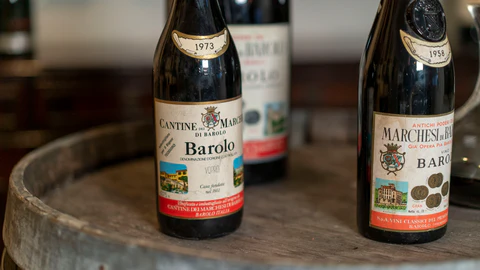
GUIDE TO THE GOOD WINE EXPERIENCE
We will help you throughout the journey. Here you can read our guide on how to treat the wine. If you have any questions, you are always welcome to write or call us.
Our customers say it best!
Based on 247 reviews


