


Wine is alive. It keeps developing in the bottle, and how you store it decides whether it gets better with age or grows tired too soon. The good news is that the rules are simple.
In this guide, we walk you through the main rules for storing wine: temperature, light, humidity, and why bottles should lie down. At the end, we show you what to do when you want to open a bottle you have kept for many years.
The five main rules
If you only remember one thing, make it this: Wine likes it cool, dark and calm. The rest is detail.
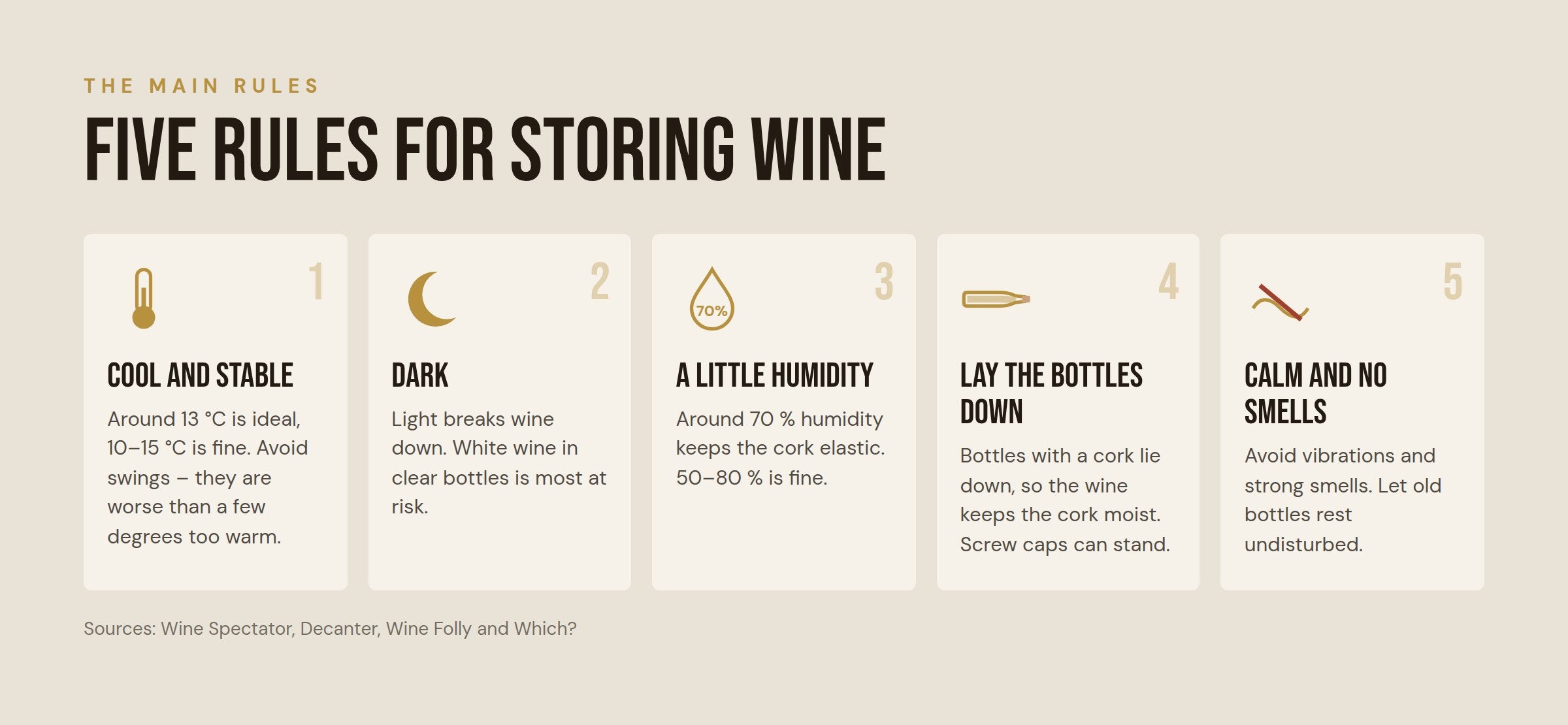
- Cool and stable. Around 13 °C is the classic ideal, and 10–15 °C is fine. A stable temperature matters more than the exact number.
- Dark. Light breaks wine down. White wine in clear bottles is most at risk.
- A little humidity. Around 70 % humidity keeps the cork elastic. 50–80 % is fine, and most homes fall within that range.
- Lay the bottles down. Bottles with a cork should lie down, so the wine keeps the cork moist.
- Calm and no smells. Avoid vibrations and strong smells, and let old bottles rest undisturbed.
Temperature: cool, but above all stable
Wine Spectator's Dr. Vinny recommends 13 °C (55 °F) as the ideal temperature. The Oxford Companion to Wine gives 10–15 °C as suitable, and Which? says that 7–18 °C is fine in the short to medium term.
Still, the most important thing is a stable temperature. Decanter explains why: When wine warms up, it expands and pushes on the cork. When it cools down again, air is drawn in. Over time, this works like a pump that lets oxygen into the bottle.
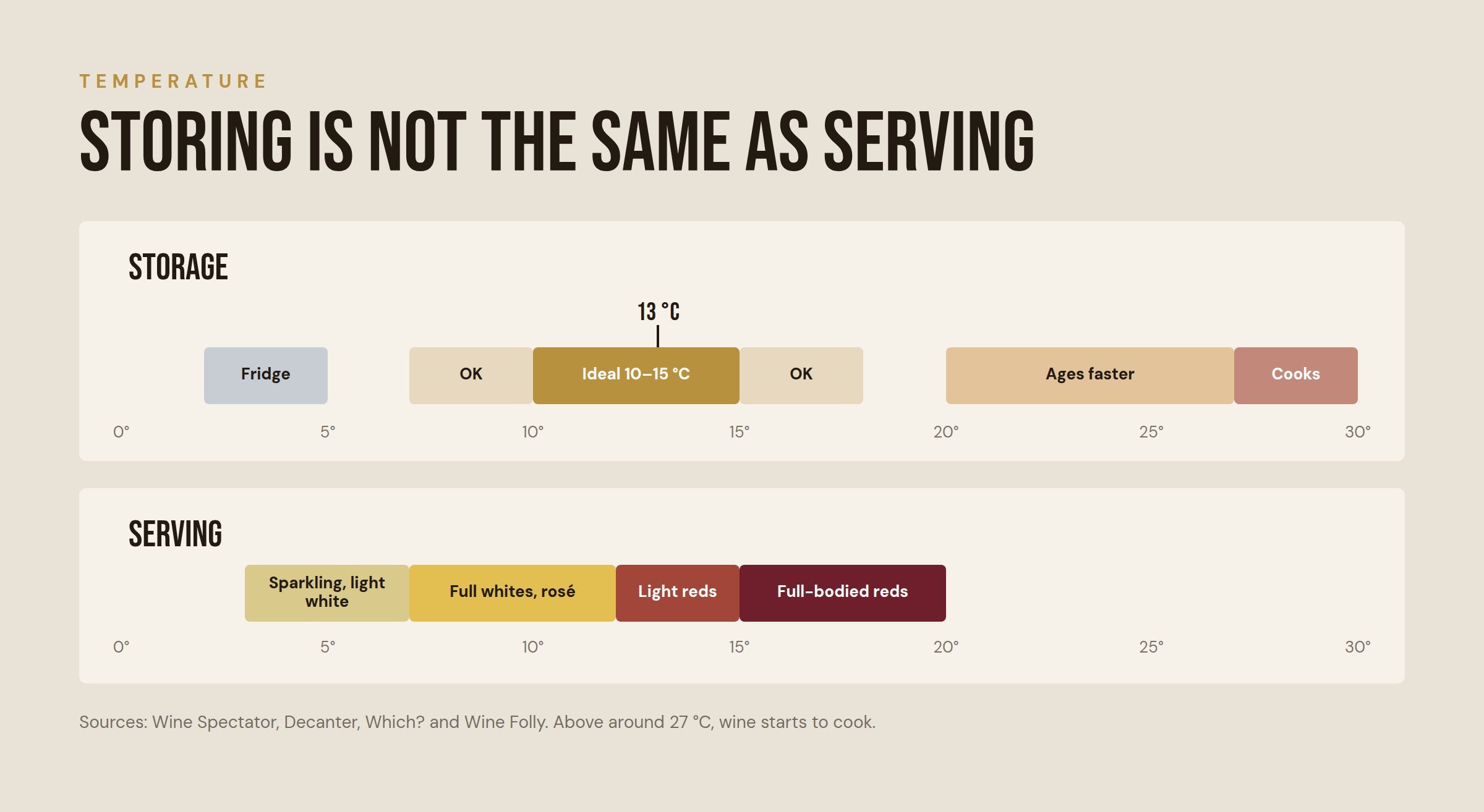
Heat makes wine age faster. According to Decanter, a wine stored at 23 °C ages on average eight times as fast as one kept at 13 °C. Wine Folly writes that above around 27 °C, wine literally starts to cook – it takes on a jammy taste of stewed prunes.
Cold is less dangerous. It can slow development and cause harmless tartrate crystals, but it does not harm the wine. Also remember that storage temperature is not the same as serving temperature:
| Wine type | Serving temperature |
|---|---|
| Sparkling and light white wines | 3–7 °C |
| Full-bodied white wines and rosé | 7–12 °C |
| Light and medium-bodied red wines | 12–15 °C |
| Full-bodied red wines | 15–20 °C |
Source: Wine Folly.
Light and humidity
Light is wine's enemy. When light hits wine, a compound called riboflavin breaks down, and sulfur compounds with an unpleasant smell are formed. This is known as “light strike”. Dark glass protects best, but even dark bottles are only fully protected in the dark. According to The Wine Drinker, cool LED and fluorescent lights can cause noticeable damage in just one day.
Humidity is less critical. Dr. Vinny recommends around 70 %, so the cork does not dry out. Air that is too dry can make the cork brittle, while a lot of moisture can cause mold on the labels. Which? notes that most homes fall within the recommended 50–80 %.
Lying down or standing up?
Bottles with natural cork should lie down. That way the wine touches the cork and keeps it moist, so it does not dry out and let air in. Screw caps and synthetic corks do not need to lie down.
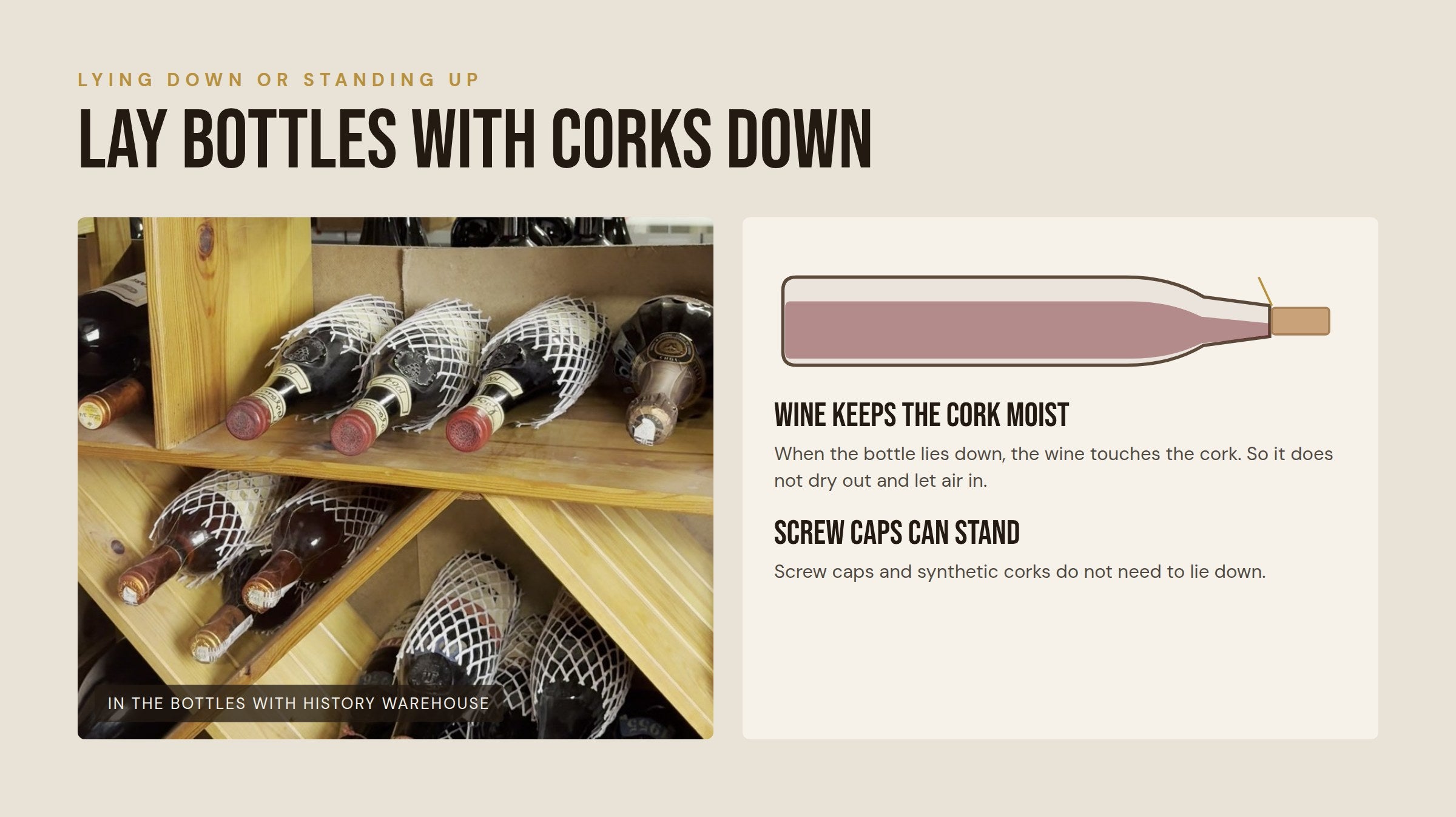
There is a debate on the subject. The head of research at cork producer Amorim believes the air in the bottle neck is so humid that the cork never dries out – not even when the bottle stands upright. But most experts still recommend laying bottles down, and it saves space too.
Where should you keep wine at home?
You do not need a wine cellar. But you should choose the spot with care.
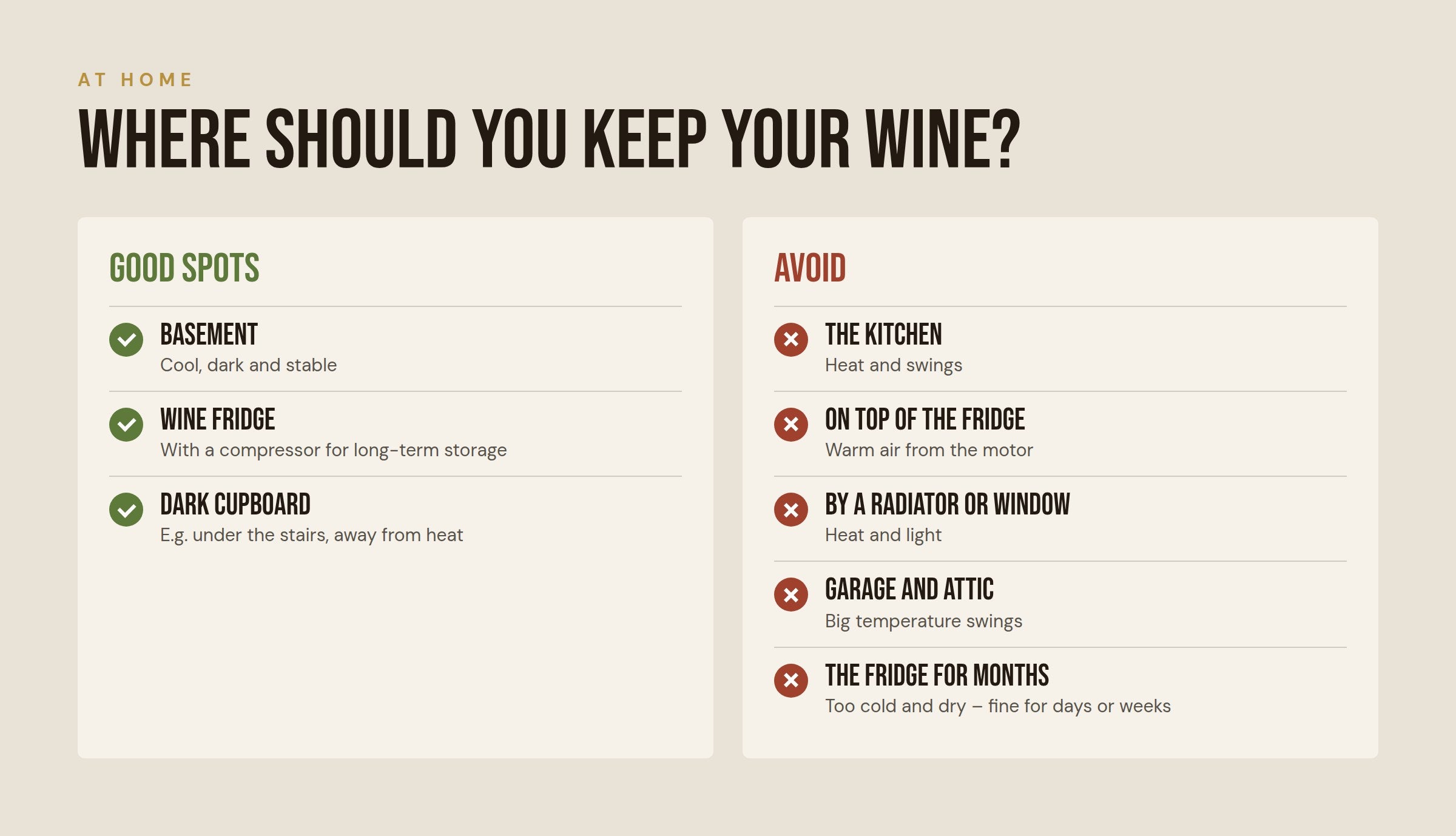
- Good spots: a basement, a wine fridge with a compressor, or a dark cupboard, for example under the stairs.
- Avoid: the kitchen, the top of the fridge, spots close to radiators and windows, and the garage and attic, where the temperature swings a lot.
- The regular fridge is fine for a few days or weeks. According to Dr. Vinny, it is too cold and dry for long-term storage, and the cork can dry out after a couple of months.
When you want to open the bottle
If you have kept a bottle for many years, it is worth doing it properly when the time finally comes to open it. Old wines often have sediment, and they are more fragile than young wines.
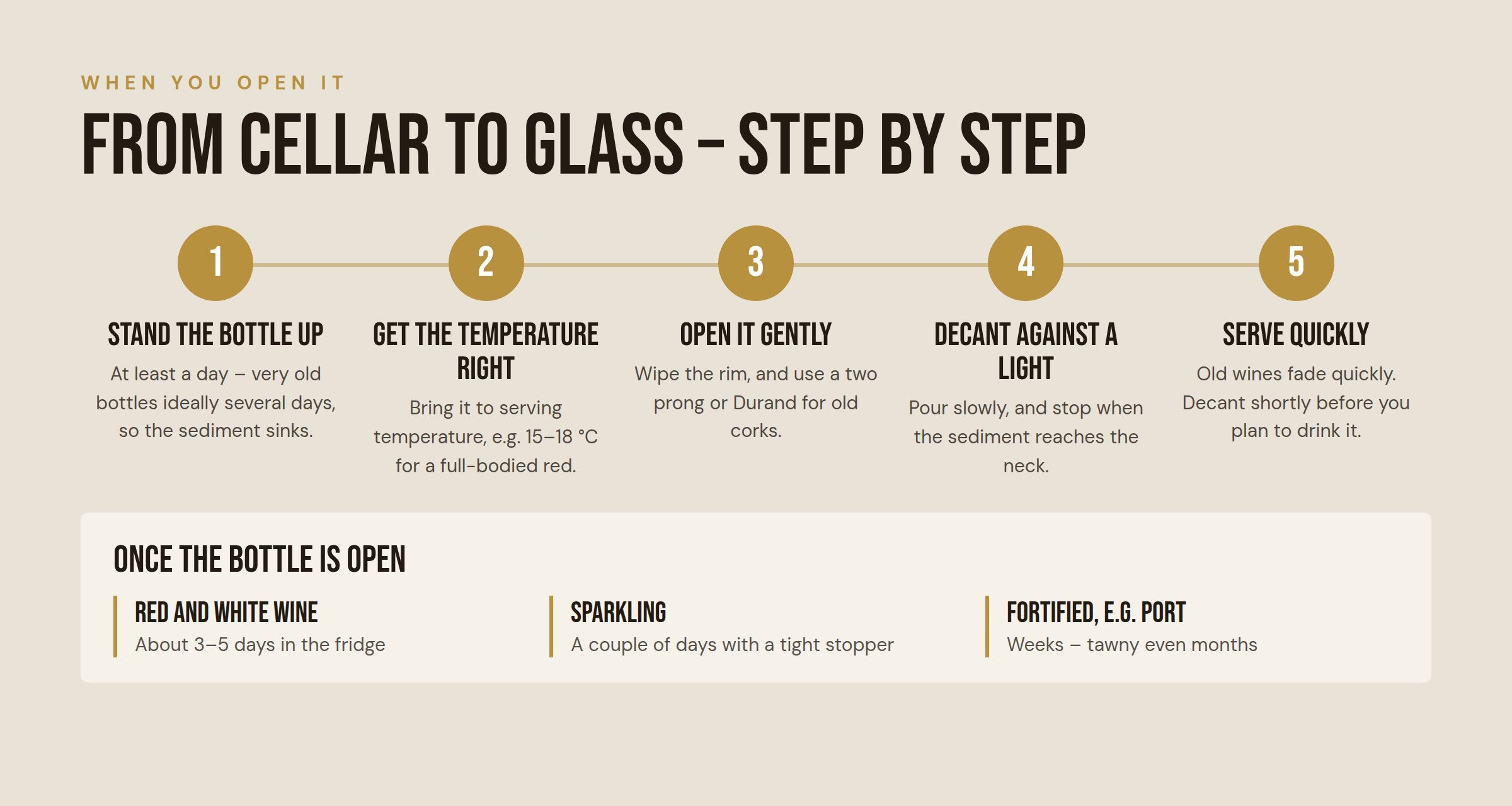
- Stand the bottle up. Wine Spectator recommends at least a day, so the sediment can sink to the bottom. Vinous recommends several days for very old bottles.
- Get the serving temperature right. Take it out in good time, so it reaches the right temperature.
- Open it gently. Wipe the rim of the bottle, and use a two prong or Durand for old corks. Read our guide on how to open vintage wine.
- Decant against a light. Pour slowly with a light source under the bottle neck, and stop when the sediment reaches the neck.
- Serve quickly. Old wines fade faster than young ones. Wine Spectator recommends decanting very old wines only about 30 minutes before serving.
If you are unsure whether an old wine is still good, read our article on whether old wine can make you sick. In short: It cannot.
Once the bottle is open
| Wine type | How long it keeps after opening |
|---|---|
| Red and white wine | About 3–5 days in the fridge with the cork in |
| Sparkling | A couple of days with a tight champagne stopper |
| Fortified wine, e.g. port | Several weeks – tawny even a few months |
Sources: Decanter and Wine Spectator. Always put the cork back in, and keep the bottle in the fridge.
Want to know more about older wines? Our guide to vintage wine gives a good overview. And if you are looking for a bottle to lay down, take a look at our selection of old and vintage wine.
Sources
- Wine Spectator: Dr. Vinny, “Dr. Vinny Frequently Asked Questions”, September 2017.
- Wine Spectator: Dr. Vinny, “My wine fridge is only 44° F. Is that too cold for storing wine?”, April 2018.
- Wine Spectator: Dana Nigro and MaryAnn Worobiec, “Decanting 101”, March 2019.
- Decanter: John Stimpfig, “Keeping cool: Wine storage”, December 2001 (with quotes from The Oxford Companion to Wine).
- Decanter: “Wine cellar temperature fluctuation – ask Decanter”, January 2019.
- Decanter: “How long should you keep wine open? – ask Decanter”, April 2017.
- Wine Folly: Madeline Puckette, “Wines Like It Cool, Dark, and Moist” and “Ideal Serving Temperature for Wine (Red and White)”.
- Wine Folly: Chad Wasser, “Your Bottle May Be Suffering From Wine Heat Damage”.
- Which?: Patrick Gallagher, “Five top tips for storing wine at home”, June 2020.
- VinePair: Tim McKirdy, “Scientist Says Storing Wine Sideways is 'Bullshit'”, June 2018.
- The Wine Drinker: Simon Judge, “Light Strike Can Cause Wine Degradation in Just One Day”, December 2025.
- Vinous: Kelli White, “Tips on Opening and Decanting Older Wines”, April 2015.


